
Why Does My Child Have Cavities Even Though We Brush?
You brush the tiny teeth. You remind them to spit. You limit the obvious sweets, say no to the extra juice box, and do your best to make bedtime brushing happen, even on the nights when everyone is tired.
Then your child’s dentist says the word you were hoping not to hear:
Cavities.
For many parents, especially parents of preschoolers, the first thought is not just, “What happens next?”
It is, “How did this happen?”
You may start replaying every snack, every skipped flossing attempt, every rushed morning, and every bedtime when brushing turned into a negotiation. It can feel confusing. Frustrating. Even a little heartbreaking. Because you were trying.
First, take a breath. A 4-year-old having cavities does not mean you failed as a parent.
Childhood cavities can happen even in families that care deeply about dental health. That does not mean cavities should be ignored. It means you are not the only parent sitting with this question.
Brushing matters. A lot. But brushing is only one part of cavity prevention.
Tiny teeth can also be affected by snack timing, tooth shape, brushing technique, fluoride exposure, flossing, enamel strength, oral bacteria, and how often a child sips or grazes throughout the day.
Sometimes parents really are doing their best, and there are still hidden cavity triggers they were never clearly taught to look for.
At Hurst Pediatric Dentistry, we believe parents deserve clear answers without guilt. Our goal is to help families understand what is happening, protect their child’s comfort, and create a prevention plan that feels realistic at home.
In this guide, we will walk through why a child can get cavities even when you brush, why cavities can happen in 4-year-olds, and what parents can do to lower the risk of more cavities without turning home care into a daily battle.
Why Brushing Is Not Always Enough

Brushing is one of the best things you can do for your child’s smile.
But it is not the only thing that determines whether cavities develop.
Cavities happen when bacteria in the mouth interact with sugars and carbohydrates, creating acids that weaken tooth enamel over time. For young children, that process can happen faster than many parents expect because baby teeth are small, brushing can be tricky, and daily routines are not always perfectly predictable.
That is why a child can brush every day and still have cavities.
It does not automatically mean brushing was ignored. It usually means there were one or more cavity risk factors working quietly in the background.
Brushing frequency is not the same as brushing effectiveness
Many preschoolers want to brush by themselves, and that independence is worth celebrating.
The challenge is that most 4-year-olds do not yet have the coordination to clean every surface well, especially the back teeth. They may scrub the front teeth, chew on the toothbrush, or finish in 20 seconds and proudly announce they are done.
That is very normal. At this age, brushing works best as a team effort.
Your child can take a turn first. Then a grown-up can do a quick finishing brush to reach the molars, gumline, and other easy-to-miss spots.
This keeps your child involved while making sure the areas most likely to collect plaque get the help they need.
Some teeth have deeper grooves that trap food
Baby molars are not smooth little tiles.
They often have grooves, pits, and uneven chewing surfaces where food and plaque can settle. Even with daily brushing, sticky or starchy foods can stay tucked into those grooves if the toothbrush does not reach them well.
Some children simply have tooth shapes that make certain areas harder to keep clean.
A pediatric dentist can point out where buildup tends to collect and show you how to angle the brush so those tiny grooves get more attention.
Cavities can start between teeth where toothbrushes do not reach
Toothbrushes are great for the tops, fronts, and backs of teeth. But they cannot fully clean between teeth that touch.
Once your child’s teeth begin sitting close together, flossing becomes an important part of cavity prevention.
This surprises many parents because preschoolers may still seem too little for flossing. But if two teeth touch, food and plaque can hide between them.
That is why some children get cavities between teeth even when the visible surfaces look clean.
Some children are more cavity-prone than others
Every child’s mouth is a little different.
Some children have stronger enamel, more protective saliva, wider spacing between teeth, or lower levels of cavity-causing bacteria.
Others may be more cavity-prone because of enamel differences, dry mouth, mouth breathing, genetics, diet patterns, or previous cavity history.
This does not mean future cavities are unavoidable. It simply means prevention may need to be more personalized.
Hurst Pediatric Dentistry emphasizes individualized care and parent education, helping families understand their child’s specific needs instead of giving every parent the same one-size-fits-all advice.
Brushing can help, but timing matters too
Even excellent brushing at night cannot fully erase a full day of frequent snacking or sipping.
Teeth need breaks between meals and snacks so saliva can help neutralize acids and support enamel. When a child grazes often, sips juice slowly, or has milk after brushing, the teeth may spend more time exposed to cavity-causing acids.
That does not mean every snack is a problem.
It means the rhythm of eating and drinking matters. A few small changes in timing can sometimes make a big difference. The most helpful way to think about it is this:
Cavities are rarely caused by one single mistake. They usually come from a mix of small factors that build up over time.
Once you understand those factors, you can make smarter, calmer changes without feeling like your whole routine has to be perfect.
The Hidden Cavity Triggers Parents Often Miss
Once parents hear their child has cavities, they often look for the obvious cause. Candy. Cookies. Skipped brushing. Too much juice.
And yes, those things can play a role. But many childhood cavities are connected to smaller patterns that are easier to miss. A child may be brushing every day, eating what looks like a normal kid-friendly diet, and still have habits that keep their teeth exposed to cavity-causing acids for longer than parents realize.
The good news is that once you know what to look for, prevention becomes much more practical.
Frequent snacking keeps teeth working harder

Cavity risk is not just about what your child eats. It is also about how often they eat.
Every time a child has a snack or sweet drink, the bacteria in the mouth use those sugars and carbohydrates to create acids. Those acids temporarily weaken the enamel. Saliva helps the mouth recover, but it needs time between eating and drinking to do its job.
When a child grazes throughout the day, even on small snacks, the teeth may not get enough of a break. A few crackers here, a pouch there, a sip of juice, a bite of a granola bar, and suddenly the teeth have been exposed again and again.
This does not mean snacks are off-limits. Preschoolers need fuel.
The goal is to create a rhythm: meals, planned snack times, and water in between whenever possible.
“Healthy” snacks can still stick to tiny teeth
A snack can be nutritious and still be tough on teeth if it sticks in grooves or between teeth. Parents are often surprised to learn that some common kid snacks linger longer than expected.
Foods like crackers, pretzels, dried fruit, fruit snacks, granola bars, chips, and gummy vitamins can cling to the chewing surfaces of baby molars. Some break down into soft, sticky pieces that sit in the grooves of the teeth after the snack is over.
This does not mean these foods are “bad.” It means they are worth noticing.
If your child loves sticky or starchy snacks, offering water afterward, pairing snacks with meals, and brushing carefully at night can help lower the risk.
Bedtime drinks can increase cavity risk
Nighttime is one of the most important times to protect teeth. During sleep, saliva flow naturally slows down, which means the mouth has less help rinsing and neutralizing acids.
If a child has milk, juice, chocolate milk, a smoothie, or any drink other than water after brushing, sugars can sit on the teeth overnight.
This is one of those hidden habits that can affect even families who brush faithfully every night. A simple rule can help: After nighttime brushing, only water.
If your child is used to a bedtime drink, the transition may take time. But it can be one of the most helpful changes for protecting tiny teeth.
Rinsing after brushing may wash away fluoride too soon
Many parents grew up brushing, rinsing, and spitting until their mouths felt completely clean. For kids, that routine may wash away some of the fluoride before it has enough time to sit on the teeth.
Fluoride helps strengthen enamel and supports cavity prevention. After brushing, it is often better to have your child spit out the extra toothpaste rather than rinse heavily with water right away.
This allows a small amount of fluoride to stay on the teeth longer.
Because toothpaste amounts vary by age, this is a great topic to ask your pediatric dental team about. They can show you the right amount for your child and help you feel confident that you are using it safely.
Sippy cups and slow sipping can stretch out exposure
A drink that would be less concerning at mealtime can become a bigger cavity trigger when a child sips it slowly over a long period. Juice, flavored milk, sports drinks, sweet tea, and even regular milk can keep bathing the teeth when carried around in a cup.
For many families, cups become part of the routine: in the car, at daycare pickup, during screen time, or while winding down.
The habit is understandable. But if the drink is not water, the teeth may be getting repeated exposure throughout the day.
Keeping water as the default between meals is a simple way to reduce that exposure without making every drink feel like a battle.
Brushing battles can leave the same spots missed every day
Some children are wigglers. Some clamp down. Some insist they already brushed. Some are tired, silly, or deeply uninterested in dental hygiene at exactly the moment you need them to cooperate.
When brushing is a daily battle, parents naturally do the best they can. But the same areas may get missed over and over, especially the back molars and gumline.
Over time, those missed spots can become cavity-prone areas. That does not mean you need a perfect brushing routine.
It means your routine may need a small adjustment that works better for your child’s age, temperament, and attention span.
The pattern matters more than one “bad” day
One skipped flossing attempt or one birthday cupcake does not usually explain a cavity by itself. Cavities tend to come from repeated patterns over time. That is actually hopeful news.
It means prevention does not require perfection.
Small, consistent adjustments can make a real difference: more water between meals, a grown-up finishing the brushing, flossing where teeth touch, limiting drinks after bedtime brushing, and asking your pediatric dentist where your child’s teeth need the most attention.
You do not have to rebuild your whole life around cavity prevention. You just need to understand which small habits matter most for your child.
Are Cavities Common in 4-Year-Olds?
Yes, cavities can happen in 4-year-olds.
They can happen even when parents are paying attention, brushing every day, and trying to make good choices. That can be hard to hear because many parents assume cavities only happen when dental care has been ignored. In reality, preschoolers are in a tricky stage for cavity prevention.
Baby molars are being used every day. Snacks become more independent. Children may be learning to brush, but they still need help reaching every surface. Teeth may be closer together, which means flossing becomes more important.
Some children also have a higher cavity risk because of tooth shape, enamel differences, mouth breathing, diet patterns, or previous cavity history.
That does not mean cavities are “no big deal.” It simply means your family is not the only family facing this.
A cavity is not a parenting report card. It is information. It tells us that one or more parts of your child’s oral health routine may need extra support.
This is why the best next step is not guilt. It is a plan. A pediatric dental visit can help identify where the cavities are forming and what that pattern may mean.
A cavity between teeth may suggest flossing needs more attention. A cavity on a back molar may point to deep grooves where food gets trapped. A cavity near the gumline may show where brushing needs a different angle.
Once parents understand the “why,” prevention usually feels less mysterious and much more manageable.
So if your 4-year-old has cavities, you are not alone. And you are not out of options.
With gentle care and a few targeted habit changes, your child can move forward with a healthier smile and a more confident dental routine
What Parents Can Do Next
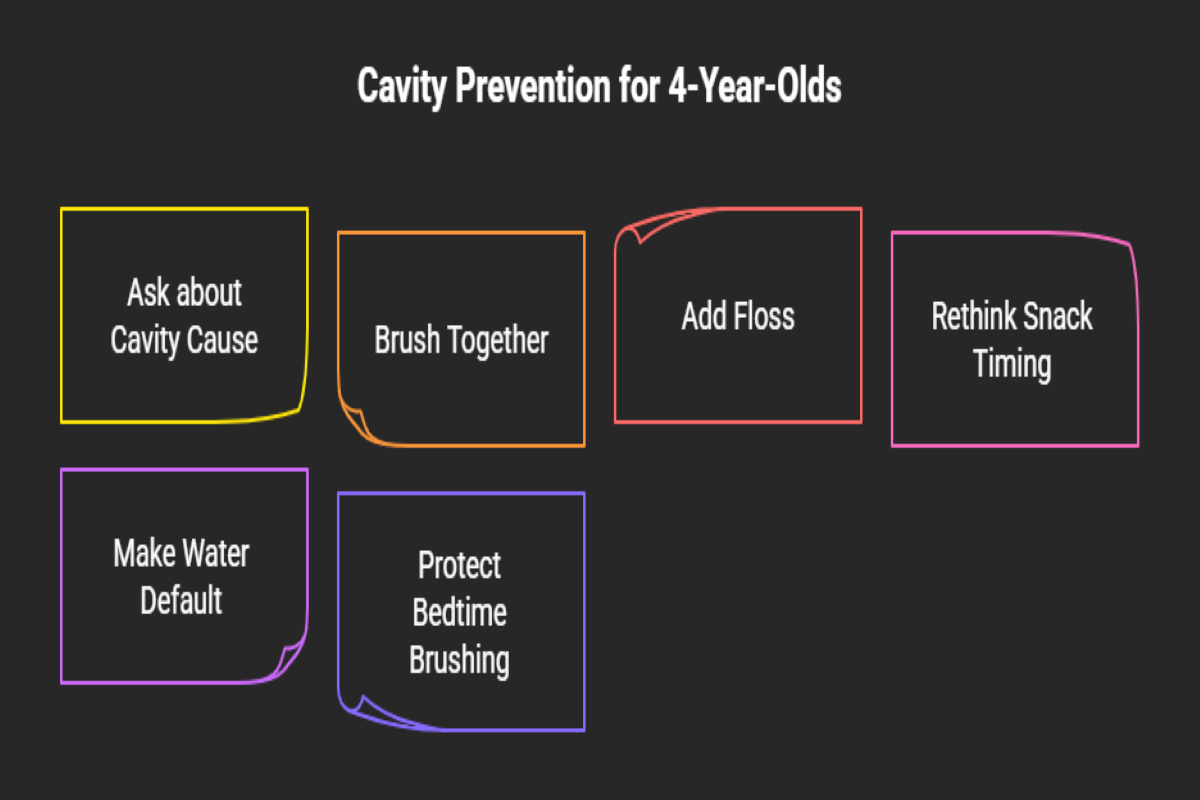
Once you find out your child has cavities, it can feel like you need to change everything at once. New toothbrush. New toothpaste. New snack rules. New flossing routine. New bedtime plan.
That instinct makes sense, but big changes can quickly turn into daily power struggles, especially with a preschooler. The better goal is not perfection.
It is consistent.
Ask what likely caused the cavity
One of the most helpful questions you can ask is: “Where did the cavity form, and what does that tell us?”
The location of the cavity can give clues.
A cavity between teeth may mean flossing needs to become part of the routine. A cavity on a back molar may point to deep grooves where food gets trapped. A cavity near the gumline may mean brushing needs a small adjustment in angle or technique.
This is where a pediatric dental team can be especially helpful.
Hurst Pediatric Dentistry emphasizes parent education, prevention, and personalized care, helping families understand their child’s specific needs instead of leaving parents to guess.
Brush together, not just nearby
At 4 years old, many children want to brush by themselves. That independence is wonderful, but they still need help. A good routine is to let your child brush first, then have a grown-up do the “finish-up brush.”
You can make it feel less like taking over and more like teamwork: “Your turn first, then my turn to catch the sneaky spots.”
Use gentle, playful language that keeps brushing positive. The goal is not to make your child feel like they did it wrong.
The goal is to make sure the back teeth, gumline, and chewing surfaces get the attention they need.
Add floss when teeth touch
If your child’s teeth touch each other, brushing alone cannot clean those tight spaces. Flossing helps remove plaque and food from areas a toothbrush cannot reach.
This does not need to be perfect on the first try. Many parents find floss picks easier for young children than traditional string floss.
You can start with the tightest spots, especially where your pediatric dentist says cavities are more likely to form. Think of flossing as a skill your child grows into.
At first, the win is simply making it part of the routine.
Rethink snack timing, not just snack choices
Parents often focus on whether a snack is “healthy” or “sugary,” but timing matters too. Teeth need breaks between meals and snacks so saliva can help clean the mouth and support enamel.
Instead of letting snacks stretch across the whole afternoon, try creating set snack times. Offer water between meals when possible.
This gives your child’s teeth more recovery time without requiring a perfect diet. You do not have to eliminate every cracker, granola bar, or fruit snack. You just want to be aware of how often those foods are touching the teeth throughout the day.
Make water the default between meals
Water is one of the easiest smile-friendly habits to build. It helps rinse the mouth, keeps kids hydrated, and does not coat teeth with sugar.
If your child is used to juice or milk throughout the day, try shifting those drinks closer to mealtimes and offering water in between.
Small changes are still progress, especially when you are building habits with a preschooler.
Protect bedtime brushing
Nighttime brushing is the routine to guard most carefully. Once teeth are brushed for the night, try to stick with water only.
This can be a big adjustment if your child is used to milk or another drink before falling asleep. If that is part of your current routine, you can move the drink earlier and then brush afterward. The goal is to avoid letting sugars sit on the teeth overnight when saliva flow slows down.
When Should Parents Call a Pediatric Dentist?
Some dental concerns can wait for a regular checkup.
Others are worth calling about sooner, especially when your child is uncomfortable, avoiding certain foods, or acting differently during meals or brushing.
Parents do not need to diagnose the problem at home. That is what the dental visit is for. Your job is simply to notice changes and reach out when something feels off.
Call if your child mentions tooth pain or sensitivity
Young children do not always describe dental discomfort clearly. A 4-year-old may not say, “My tooth hurts when I chew.”
They may say their food feels “too cold,” chew only on one side, refuse a favorite snack, or suddenly dislike brushing in one area.
Sensitivity to cold, sweet foods, or chewing pressure can be a sign that a tooth needs attention. It does not always mean something serious is happening, but it is worth checking before the concern becomes harder to manage.
Call if you notice a dark spot, hole, or rough area
Not every dark spot is a cavity. But changes in color, texture, or shape should be evaluated by a pediatric dentist.
If you see a small hole, chipped area, or rough spot where food seems to get stuck, take note of where it is and mention it when you call.
Call if eating or brushing suddenly becomes harder
A child who suddenly resists brushing may simply be tired or testing boundaries. But if the resistance is new, intense, or focused on one side of the mouth, discomfort may be part of the reason.
The same is true for eating.
If your child avoids crunchy foods, chews carefully, holds food in their cheek, or complains during meals, a dental check can help rule out a cavity, gum irritation, or another concern.
Call if there is swelling, a bump, or gum tenderness
Swelling near a tooth, a pimple-like bump on the gums, or tenderness that does not go away should be checked promptly. Try to stay calm when you call.
The dental team can help you decide how soon your child should be seen and what to do in the meantime.
Call if you are unsure
You do not need a perfect reason to call. If something about your child’s teeth, gums, or comfort level is making you uneasy, it is okay to ask.
A helpful rule of thumb is this: If your child is in discomfort, avoiding normal foods, showing visible changes in the mouth, or your parental instincts are telling you something is not right, call a pediatric dentist.
It may be a small issue. But catching small issues early is one of the best ways to keep dental care simple and positive.
A Gentle Reminder: Good Parents Can Have Kids With Cavities
If your child has cavities, it is easy to turn the diagnosis into a personal failure. Parents often replay everything they did or did not do:
The rushed brushing.
The extra snack.
The nightly flossing did not happen.
The juice at a birthday party.
The months when everyone was just trying to get through a busy season.
But cavities are not a measure of how much you love your child. Good, attentive, caring parents can have children with cavities.
Tiny teeth are affected by many things at once: brushing technique, snack timing, tooth shape, fluoride exposure, flossing, enamel strength, bacteria, and daily routines that change as kids grow.
Sometimes a cavity shows up not because a parent ignored dental care, but because a child needed a more personalized prevention plan.
That is where the story can shift. Instead of asking, “What did I do wrong?” try asking:
“What do we know now that can help us protect their smile going forward?”
That one question moves the focus away from guilt and toward guidance. A cavity diagnosis is not the end of your child’s healthy smile story.
It can be the beginning of a clearer plan.
Where to brush more carefully.
When to add floss.
How to adjust snacks and drinks.
How often should your child be seen for preventive care?
At Hurst Pediatric Dentistry, parents do not need more guilt. They need clear answers, gentle care, and a dental team that sees the whole child.
So if you are sitting with the thought, “We did everything right, and my 4-year-old still had cavities,” please hear this:
You are not alone. You are not behind. You are not a bad parent. You are a parent who got new information, took the next step, and is learning how to help your child’s smile stay healthy.
Helping Your Child Build a Healthy Smile

A cavity diagnosis can feel discouraging at first, but it can also become a turning point. Once you understand why cavities may be happening, you can stop guessing and start building a plan that fits your child’s real life.
That plan does not have to be perfect. It just needs to be clear, consistent, and kind.
A stronger brushing routine, help with flossing, more water between meals, protected bedtime brushing, and regular pediatric dental visits can all work together to support your child’s growing smile.
Just as important, your child can learn that dental care is not something to fear.
With gentle guidance and positive experiences, they can begin to feel proud of taking care of their teeth. If your child has cavities, or if you are wondering why cavities keep showing up even though you are trying hard at home, our team can help you understand what is happening.
We will walk you through your child’s needs, answer your questions clearly, and create a gentle prevention plan for healthier little teeth.
Schedule a pediatric dental visit today and let’s help your child build a healthy smile one small step at a time.
